


Mermaids, Banking and Ballet
These words reflect the writing and career of Mary Krakow, a finalist in the flash fiction category of our ‘Wild Atlantic Writing Awards’ on the theme of ‘secrets.’

Mary, who now lives in the high desert of Oregon, was joined as a competition finalist by Dublin-based Lorcan Fidgeon who worked in the publishing field, Teresa Preziosi, a former university professor from Pennsylvania and Barbara Bridger from Yorkshire, who once taught theatre and performance writing.
Before learning about more the writers' lives, please be aware - a new WAWA competition has just been launched with the theme 'I/We knew this day would come.'
Check it out and put pen to paper (or finger-tips to computer keys). Now's your chance to flex your creative writing muscle.
Mary Krakow
California-born Mary, who creatively used mermaids in her story to highlight racism, was especially happy to be named a finalist in our ‘Wild Atlantic Writing Awards’ due to her pride in her Irish ancestry.
“My great grandfather emigrated from Ireland in 1867, eventually settling in San Francisco by way of New York, Los Angeles, and Tucson,” she said. “I look forward to returning to the land of my ancestors one day.”
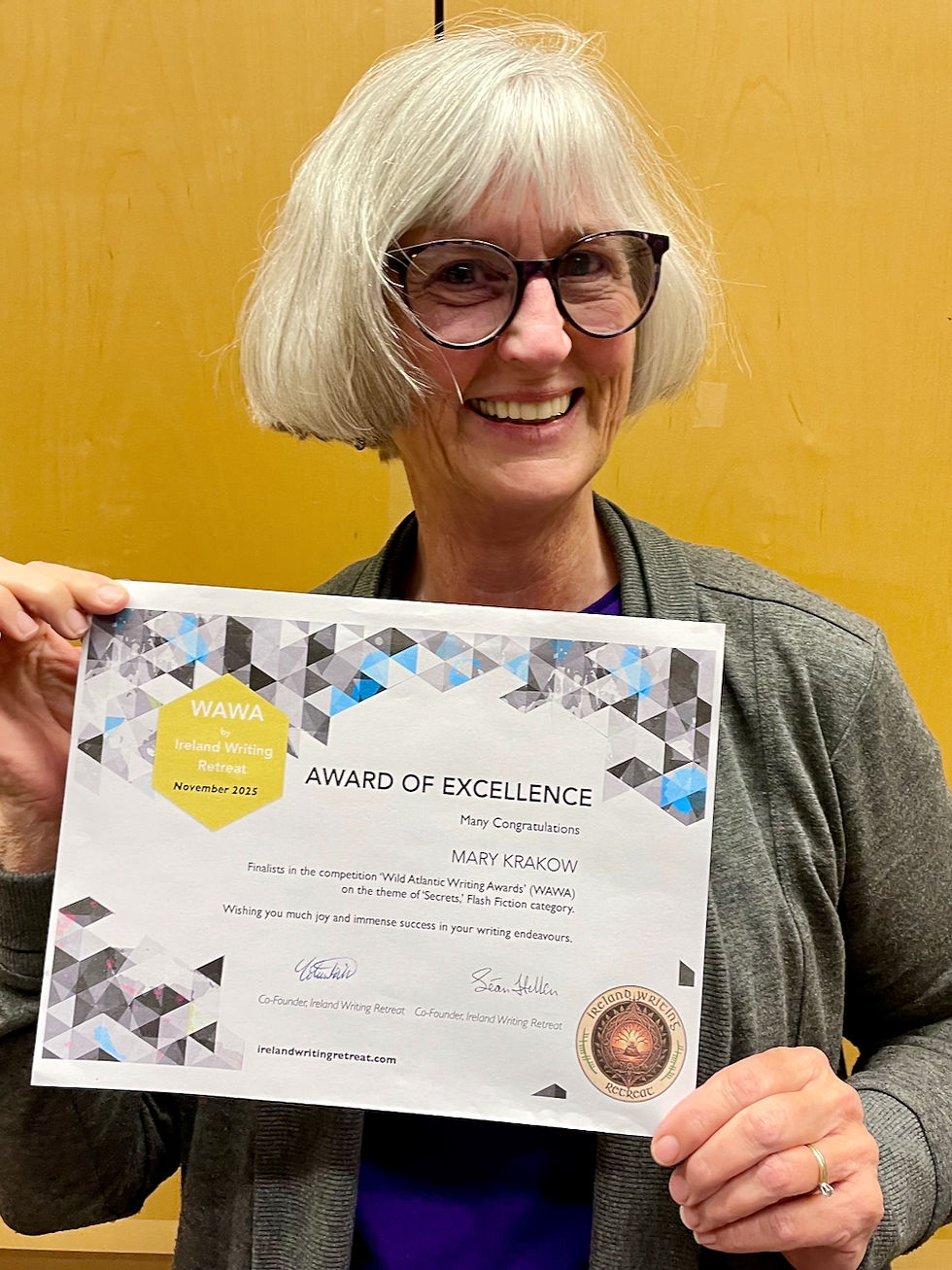
Mary was also delighted to be named as finalist for another reason, one all writers unfortunately face regularly. “Congratulations on the Email subject line was a welcome change from those other notifications,” she said. “The ones that start, ‘Thank you for the opportunity to read your work. . .”
A retired educator, Mary worked in banking before spending several years performing with a regional ballet company. Such is her zest for life and writing, when she retired over ten years ago, she joined a Facebook group, the 52 Week Flash Fiction Challenge, and wrote to a prompt word every week. Then celebrated her 70th birthday on a cruise to Alaska with her husband of 51 years.
One of the prompt words - ‘booklet’ - led to her WAWA finalist story, ‘Darya’s Sea Life.’
“Since many people were writing to the same prompt word, I wanted mine to stand out,” she said. “I thought of all the ways I could use the word and settled on a child’s report. I can’t say for certain but I was probably influenced by the George Floyd trial in which a black man was brutally murdered at the hands of police during an arrest. I wanted to portray bigotry without the ugliness and anger that often accompanies it.”
Her most difficult challenge in writing her story? “I knew who my characters were and so I knew how it had to end. The most difficult challenge was getting there without giving too much away.”
As for her writing strengths and weaknesses, “Dialogue is my strength. Weakness is a little harder to pinpoint but it’s probably punctuation. That and finding the right ending.”
Mary’s favorite literary genres are young adult and historical fiction, her favorite books being Running Out of Time by Margaret Peterson and Last of the Name by Oregon author Roseanne Parry. She also likes books by Margaret Peterson Haddix and Mark Twain.
Darya’s Sea Life
by Mary Krakow

“I’ve asked you here today to discuss Darya’s latest report.”
I reach for my husband’s hand.
The teacher continues. “We’ve been learning about sea life.” She slides a slim stapled booklet from a folder marked with our daughter’s name.
A colorful rendition of a mermaid fills the bottom two-thirds of the page. At the top, in 48-point font, Bigotry in my Classroom.
My husband and I perch on the edge of our seats. As a biracial couple, we’ve been expecting something like this.
“I’m not really sure the best way to address this.” The teacher says.
“Bigotry is a sensitive subject,” my husband says. “One I am quite familiar with.”
“Yes, but . . .”
“Dive in,” I say. “We were bound to run into this sooner or later.”
“Your daughter has a unique take on bigotry.”
“Well, of course she would. As a biracial child in a mostly white school, she experiences microaggressions every day.”
“No. That’s not it.” The teacher pauses. “Here, the best way I can explain it is to have you read an excerpt. I’ve marked it here.”
My class is full of bigots against mermaids. They act like they’re not real. But they are.
I exhale a puff of air.
“You can’t be serious?” my husband asks.
“We encourage a lively imagination, but your daughter has taken it too far. Can you have a word with her? Get her to drop this nonsense?”
My husband shoots me a warning glance.
I nod.
“We’ll talk to her,” he promises.
In the privacy of our car, I explode. “Nonsense! The nerve of that woman.”
“Now, now,” my husband soothes. “Let’s get you into the tub for a nice soak.”
“I wish you could just swim away with us back to the sea.”
“You know I can’t adapt to the water the way you and Darya can to land. Do you want to give her the talk, or should I?”
Teresa Preziosi
Teresa Preziosi, a finalist in the creative nonfiction category of WAWA with her story ‘Brief Encounter’ has experienced a helluva ride in life over the last few years.
Born in Williamsport, Pennsylvania, at the tender age of 66 she left the US for Ireland with her husband, joined a local writer’s group in Kerry, obtained her Irish citizenship three years ago, and sadly, became a widow a year later.

Her response upon receiving notification she was a WAWA finalist was uplifting - “I'm simply over the moon. Chuffed. Plus it gives me bragging rights. This wonderful honor is an incentive for me to keep working at the craft of writing instead of just dashing off scores of stories and poems and letting them languish.”
In her 20's Teresa worked in the food industry before taking up computer programming and moving to the field of pharmaceutical and medical equipment, a subject she then taught as a university professor.
As for the origin of her story. “I had written a fiction piece, but it seemed to fall flat. Then I had a chance encounter, an 'aha' moment, and wrote the non-fiction story. With repeated edits.”
Teresa quoted ‘imagination and creativity’ as being her writing strengths. I can use practically any prompt to write a story or poem. But my weakness is re-writing and editing. The former is fun, the latter, work.”
Literary fiction is her favorite genre, and the three books she has enjoyed reading most are Kim by Rudyard Kipling (for the world it painted), Anna Karenina by Leo Tolstoy (for its intricacy and depth of human emotion) and recently Prophet Song by Paul Lynch (for its daring style and artistry).
Brief Encounter
by Teresa Preziosi

The only thing notable about the SUV in the cemetery lot was my companion Betty didn’t recognise it.
It was our nearly daily pilgrimage to her parents’ graves. We strolled the hill enjoying the view and commenting on the growth of the lambs in the adjacent field. Betty didn’t recognise the three women wandering about. With black trousers and similar floral print blouses they were likely sisters, suggesting the elder one was the mother.
Their return to the gate was just ahead of ours. The two rotund black-haired women led the way followed by a large bent wom an clad in grey and relying heavily on her cane. She reached behind without turning to close the steel gate, not knowing there’s a foot latch on the bottom. Her daughter turned toward the clanging struggle just in time to see us approach and say “Mom, leave it. There’s people behind.”
They paused outside as I took over gate duty. We were now five, making conversation obligatory.
“You’ve a lovely graveyard here. I just found my mother’s grave.”
Betty and I exchanged glances.
“And what was her name?” asked Betty.
“Margaret O’Shea.”
I turned to Betty who knows everyone here, and their relatives three generations back.
“Peg O’Shea?”
“Yes, I think people called her Peg.”
She fished out a copy of the memorial card and showed it to us.“Yes, that’s Peg, her son Pat lives in Moneyflugh just over the road.”
“Just over the road!” the lead daughter exclaimed, “we tried to find it yesterday, but the road was so narrow I got nervous and turned back.”
“You are very far from everything here, no shops or anything” the mother added.
We’ve a hardware shop, two butchers, three food shops, three pubs, four restaurants and a chipper, I wonder what more she needs.
“Where are ye from?” I asked.
“Clare.”
“You’re a long way from Clare to here” Betty said.
“Oh”, I said, “the local roads are pretty much the same.”
“How do you manage? What if another car comes toward you?” the daughter asked.
I explained the local reversing etiquette and assured her anyone she encountered would intimately know the road.
Her expression remained dubious.
“How far did you get?” Betty asked.
“There was an old cottage, then there was a newer one, but after it the road got very narrow. I was nervous and turned back.”
“Oh, you were almost there.
After you pass the newer cottage there’s a load of other houses inside a clump of trees on your left. Go past them. Pat’s house is after them on the side of the hill, with lots of sheep around it. I think it’s lightish yellow, but it may have been painted since.”
We wished them luck finding the place.
As we settled into the car, Betty said “I’d be interested to know what Pat thinks when he finds out he has a sister. You know, she did look a bit like Peg.”

Barbara Bridger
Born in Hull, Yorkshire, now living in Totnes, Devon, Barbara Bridger, 78, was a WAWA finalist in the creative nonfiction category with her intriguing story 'Lying Dogs’ based on a family secret and her own personal experiences.
Barbara taught theatre and performance writing at Dartington College of Arts for almost twenty years, retiring when the college closed in 2010 and now spends her time writing and working with the international artist collective ‘PartSuspended.’
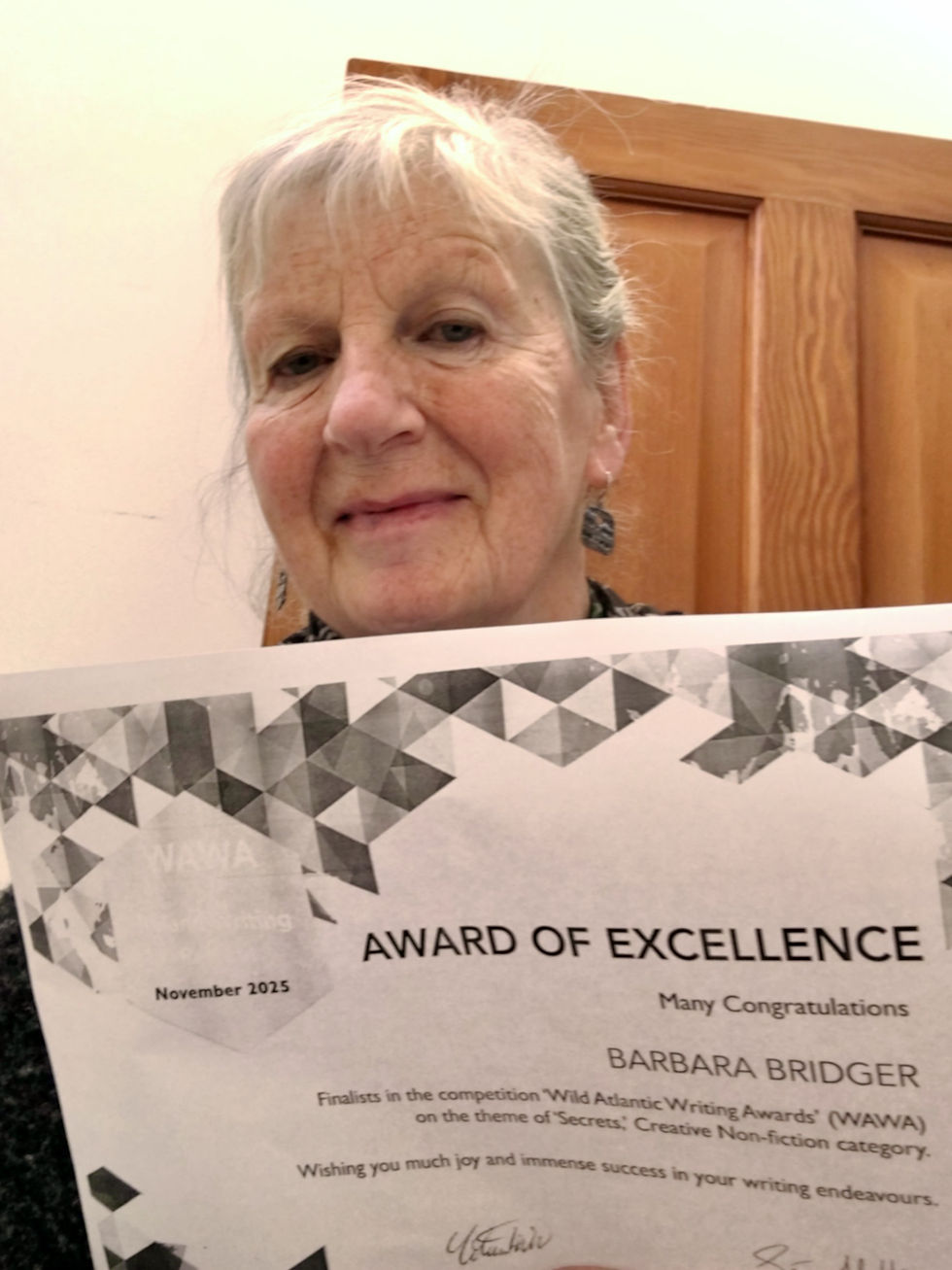
“I was very pleased to know that this piece of my personal history will have wider exposure,” she said. “In the age of the internet and digital records, some may find it hard to believe that the secrets it describes could be kept so well and for so long.”
Originally entitled, ‘Let Sleeping Dogs Lie,’ Barbara felt ‘Lying Dogs’ was a more nuanced summation of her theme.
An admirer of writers who create clear, pared-down prose with many layers of meaning and strong structure and plot, Barbara said her greatest weakness is “a tendency to over revise and edit. I can drive myself quietly mad.”
She most prefers literary fiction and her favourite novels are Foster by Claire Keegan and The Gathering by Anne Enright. She also enjoys Joseph Conrad’s writing, particularly his short stories.
Lying Dogs
by Barbara Bridger

Let sleeping dogs lie - a code passed from mother to daughter.
Moonlight is coming in through the window. It falls across my bed and onto a chest in the corner. In the drawer there’s a photograph. I take it out and hold it up, so my father’s face is caught in the moon’s beam.
My father’s smiling and wearing a uniform. When war broke out he enlisted in the RAF, because the training took a year and everyone thought the war would be over in six months. But it wasn’t and he was chosen for bomber crew. Any rear gunner has the life expectancy of a moth trapped in a lamp and any woman could feel sorry for a man with a bombing mission the next day. So that’s how it happened, how my mother got pregnant.
It was during the war, things were different then.
One night, on the way back, his plane was hit by flak. A lone parachutist falls and burns like Icarus. Missing presumed dead? No, not dead, not Charlie. He bailed out over occupied territory. German soldiers caught him and put him into a Prisoner of War Camp. He was badly injured, but alive.
When Russian soldiers finally arrived to liberate the camp, they were tired and ready to go home. They didn’t want or need extra baggage. So they asked a French priest to give the prisoners Last Rites. Horrified, the priest pleaded with the Russians and, at the last moment, the firing squad lowered their guns. The prisoners could live, but they had to march. Day after day, week after week, month after month, they tramped on behind the Russian soldiers.
My father said they followed the Vs. German military boots were very good quality, so, when a Russian killed a German, he took his boots and left his legs sticking up in the air. The POWs followed the Vs all the way to Odessa, where my father was shipped home.
When he arrived, he was emaciated and ten years younger. How could that happen?
It was after the war, things were different then.
Papers were lost, men lied. You had to be under forty for bomber crew. Charlie lied and came back a hero.
‘When did he tell you, mum?’
‘He didn’t, he had to retire. That’s when I found out.’
Ten years…. enough time for another wife, lost in London, wandering the streets, sitting on the underground, feeding pigeons in Trafalgar Square. Not even a face to put a name to.
Evelyn, her name was Evelyn.
Did my father divorce Evelyn before he married my mother? Did they have any children? Is he a bigamist? Are my sister and I illegitimate? I’m tired. These things have kept me awake too often.
A cloud moves across the moon. The room darkens. I pick up the photograph and place it back in the drawer.
Let sleeping dogs lie’ - a code passed from mother to daughter.

Lorcan Fidgeon
Travelling on a public bus when he received a message that he was a WAWA finalist, Lorcan said, “I was so delighted I nearly told the stranger sitting right next to me.”
From Cork, now living in Dublin, Lorcan Fidgeon worked in the commercial department of a magazine and earned his finalist place in the flash fiction category with his story, ‘Deposits.’
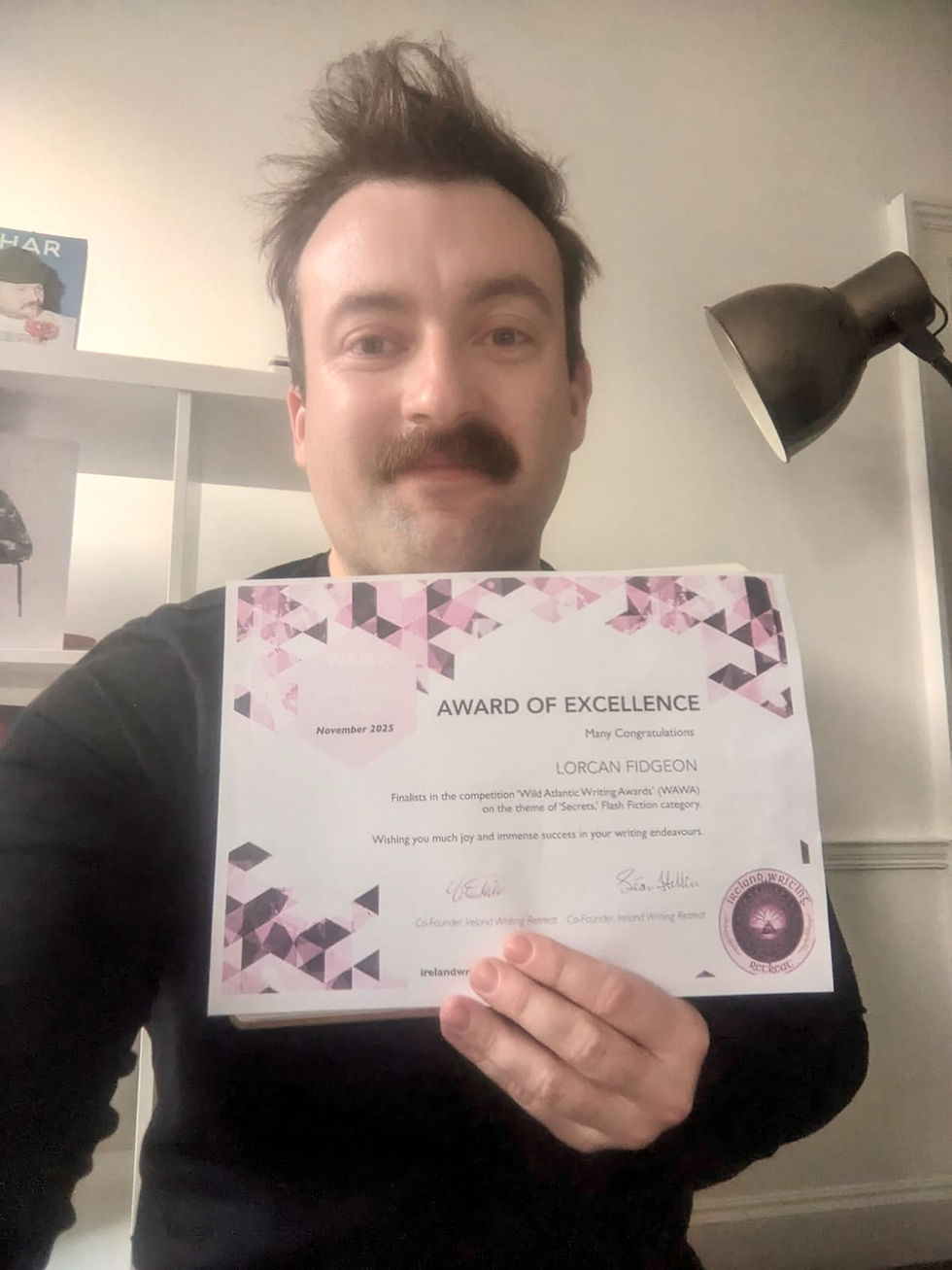
About the idea for his story, Lorcan said, “I simply asked myself where might someone with no money get the deposit for a house these days, and how many people lie about how they get the money for a deposit.”
He selected his title in the roundabout way he usually does for stories. “I often start writing without one, then put suggestions at the top of the page and choose later. I find it easier that way.”
Having completed a novel and now building a short story collection, Lorcan said dialogue is probably his greatest strength. “I write about how people speak to each other quite well. My weakness is thinking something is done before it's done.”
General literary fiction is his favorite genre and three recent books he has enjoyed most are Let Me Go Mad In My Own Way by Elaine Feeney, Dirty Havana Trilogy by Pedro Juan Gutierrez and Tropic of Violence by Nathacha Appanah.
Deposits
by Lorcan Fidgeon

The delivery driver asked for the name and verification code. James. 0145. Pizza boxes changed hands. The driver lingered. James gave him a fiver tip. He zipped off on the e-bike. His Dublin city centre bunk bed awaited. The driver had to keep telling himself it was all worth it to improve his English.
James caught the lift back up to his fiancé. He looked away from his puffy eyes in the lift mirror. Aideen was waiting in her fluffy pajamas on the bed. The floor was covered in detritus from last night’s reentry into their cocoon. His feet swished through alcohol scented rave clothing as he made his way to the bed. Aideen propped up their pillows.
She asked if he had remembered the garlic dip this time. James ignored her and told her to put on some kind of documentary or something. She pressed the garlic issue again. She was only asking if he had the garlic sorted. It didn’t come last time. Ah here, look I’m a capable person, James objected. I know you are, I just love my garlic. She opened the pizza box. The glow of the Netflix logo shimmered in the melted cheese. Any time they’re hungover they end up watching another disaster doco with the same talking heads who Cannot Believe What Happened Next. A cruise ship doco this evening.
Aideen detected some intruders in the bed. Crumbs already from you, James, she scolded. James clapped back saying, you’ll have the sauce on me now in a minute. Fuck it and sorrys were shared. They cuddled and watched the cruise ship fill up with human shite. Imagine we were on that, they said to each other. Aideen gushed, said a big I know right, and we’ll have to make sure the new place has decent plumbing. Have you managed to sell those shares you keep saying you’ll sell? I’d like to get approved on the mortgage this week. James explained the situation again in its complexity; the broker had to approve the sale of the bonds earlier than their maturity, they were Canadian so it involved dealing with multiple tax codes and entities. Plus then of course, trade issues. I’m trying hard, he said. Aideen put her hand on James’ leg as she double checked to make sure he was ok. I just want us to finally have a place of our own, and not be worried if hanging a painting will have us out on the street. He kissed her forehead and assured her they’d get there, but for now he'd pop to the bathroom. You’re always taking a shite at this time, carped Aideen.
In the bathroom he stripped and took the agreed photos for his platinum subscribers. Just four more weeks of this and he’d have the deposit money. One of them said the sperm on his leg looked strange. Feck it, Aideen had gotten the garlic sauce on him.


Comments