


Writers From Canada And Ireland Emerge Finalists In Writing Competition
Two Canadian women police officers were among finalists in our ‘Wild Atlantic Writing Awards’ (WAWA) competition on the theme of ‘secrets’ - one investigating a child’s murder, the other disguised as a prostitute in an undercover sting operation.
The finalists in the creative nonfiction category also included two women from Ireland, a librarian writing about her feelings after learning she is neurodivergent and a linguist upon discovering who her real father was.
Here are the writers and their stories.

Katrina White was born in Saint John, New Brunswick and now lives in a suburb called Quispamsis.
Now in her mid-60s, she is retired from the Royal Canadian Mounted Police, having worked in Ontario and several eastern provinces.

“My career spanned uniform police work, intelligence, drug enforcement, program development, with a little undercover work thrown into the mix, which is how my story originated,” she said. “It’s a story that’s been told several times to family and friends and always elicited laughter, so a challenge in writing it was making sure the humour of the situation came through.”
As for choosing her title, “I tried to find a title that was a double entendre between my real job and my ‘pretend job.’ ”
She likes injecting humour into her writing, but adds, “depending on what the reader prefers, that could be a strength or a weakness.”
Mystery novels and thrillers are Katrina’s choice of reading and the three books she has enjoyed most are 'Broken Country' by Clare Leslie Hall, 'A Killer Motive' by Hannah Mary McKinnon and 'Little Liar' by Mitch Albom.
Workin’ it
by Katrina White

Shhh! Don’t tell anyone… I’m a prostitute in my spare time.
By day I’m a suit wearing investigator with Canada’s National Police Force working in Toronto. Seeking fraudsters, interviewing suspects, that’s my job. In the evening, it’s another story.
Out comes the short denim skirt, a bit tattered around the edges. My flimsiest rose coloured tank top, far from laundry fresh. Some men like that ‘little bitta rough.’ Three inch pink spike heels and a small purse for prophylactics round out the ensemble.
Appalled? Hold that thought. I’m not REALLY a prostitute. I’m undercover, with the Drug Squad. They need some ‘bait’ to walk ‘the stroll.’ I volunteer.
My first evening on the ‘job‘ and SNAP goes my bra strap as my colleague jeers “this’s gotta go.” Back into the locker room, gotta ‘tart up’ my outfit.
‘Looking the part’ now sussed, my instructions were simple:
~Try to fit in with the other ‘pros,’ but don’t get friendly;
~Never, under ANY circumstances get into a vehicle with a ‘John’;
~Offer drugs then direct buyers to a predetermined location;
~Do NOT discuss prices for ANYTHING.
Fully briefed, I head out.
Sunset near the corner of Gerrard and Sherbourne and I’m dropped from an unmarked vehicle. Thank God it’s warm tonight or I’d be freezing my bits off.
Not expecting a ticker tape parade from the other women, I hadn’t considered territorial issues. Getting too friendly with them wasn’t gonna be a problem. They weren’t best pleased to see a new face.
Finding an eight-meter length of asphalt to call my own, I start my stroll. Back and forth, back and forth, like a slow moving metronome. Never being schooled in ‘seductive sashaying’, I wing it. Exaggerate the hip swing, check. Arms away from chest, check. Flick my hair repeatedly, damn that’s not gonna happen with this short bob.
Fifteen minutes, Things are quiet on my stretch of real estate.
Sixty minutes. No one? What is WRONG? It’s the short hair, isn’t it! Is it my outfit?
Ninety minutes. This is fuckin’ boring AND a waste of time.
Two hours. Enough! I’m cold, I’m unappealing, and I’m a failure at my assignment. Three strikes! I’m outta here!
Shoulders hunched and head hanging, I walk the few blocks back to the office. Hey, dammit…why no signal to come in? Were my cover team even WATCHING me?
I find them busy with paperwork. “Sorry guys, no one wanted to buy anything tonight. Are we gonna head home?”
“You can,” came the clipped reply of a distracted colleague. “We’re processing the arrests we made.” Left unsaid was ‘that we didn’t need you for.’ But I felt it, right in the pride.
Cleaned up and dressed more ‘normal,’ I travel home on public transit. Invisible amongst my fellow commuters, I examine my thoughts. Can I ever admit that not being successful as a sex worker is a blow to my ego? Maybe I’ll just keep that to myself.

Niamh Hammel grew up in Wexford but now lives in Louth with her husband. She described herself as “over the moon” upon learning she was a WAWA finalist.
“I’m a qualified librarian and after working in Dundalk Institute of Technology for five years, I took a career break to travel the world,” she said. “Since returning to Ireland, I have not been back to the Institute but have been working remotely as a copy-editor for an Irish education website. The year I turned thirty, I asked myself a question that hit home so resoundingly that I knew it was true: I was on the spectrum. I found it an incredibly difficult thing to accept about myself and so I turned to writing to help me process this revelation.
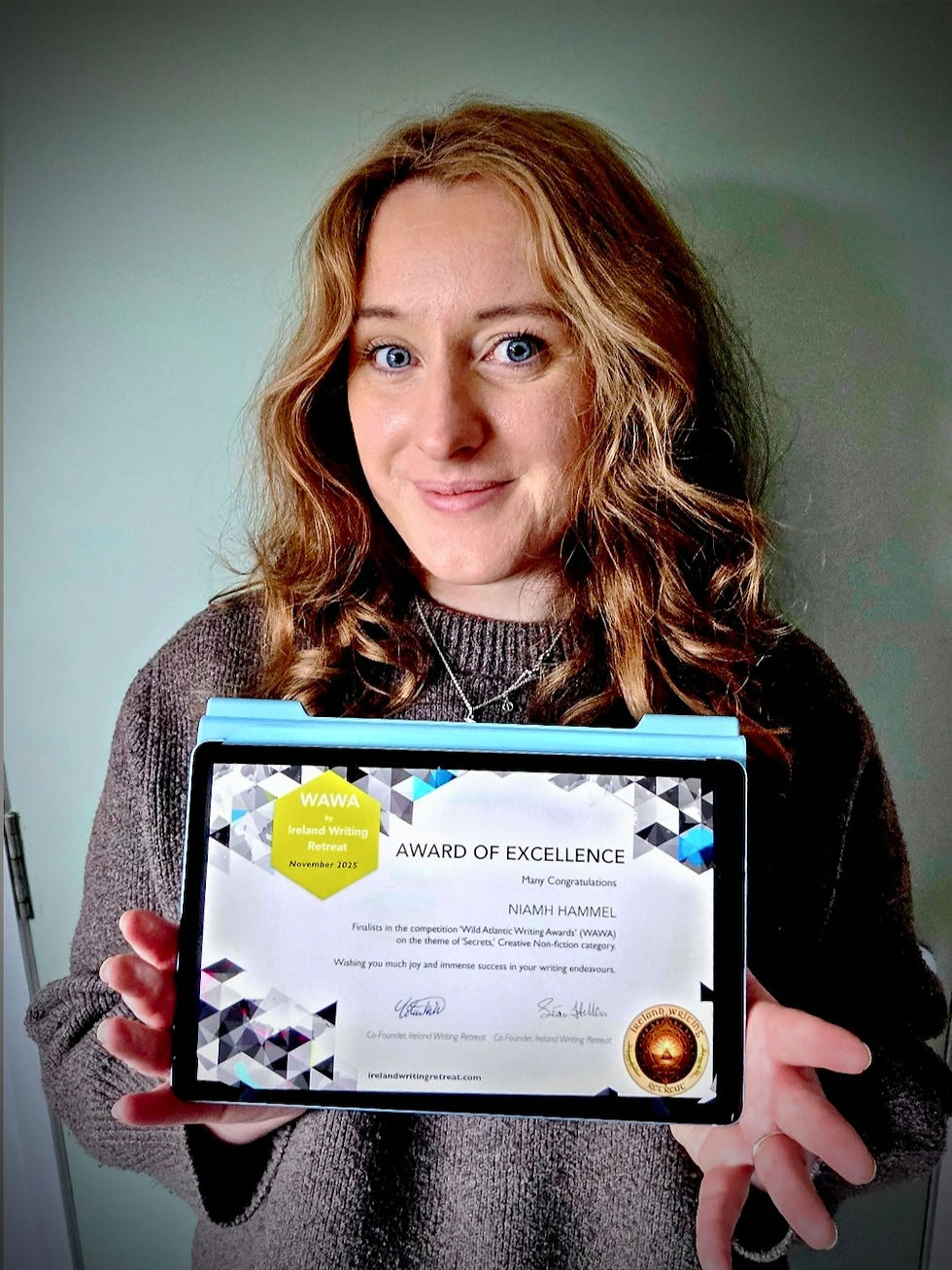
When I came across the ‘Wild Atlantic Writing Awards’ competition on ‘secrets,’ it felt like the perfect opportunity to submit something on my experience because being on the spectrum felt like a secret I had been keeping from myself all my life. Of course, it was also easier to share this story with strangers and I did not expect to be a finalist. When it was announced I was one, I certainly felt validation in my writing as well as in my personal story.
Niamh said she finds creative writing therapeutic. “Before turning to writing as a means to heal and process, I would have thought a strength of mine was imagination in creating fictional characters and worlds. But now, I'm finding my stride in creative non-fiction where writing what I know feels challenging, yes, but also empowering and authentic.”
On her favorite books and genres, she said, “My go-to genre for reading is dystopian with a smattering of sci-fi. Three books I have thoroughly enjoyed include 'Ready Player One' by Ernest Cline, 'Project Hail Mary' by Andy Weir and 'The Boy on the Bridge' by Mike Carey."
Rising
by Niamh Hammel

A terrible beauty was born the day I realised the invisible enemy I had been fighting for thirty years was myself all along. It was an act of such self-betrayal that I don’t see a day in the future that its reverberations won’t be felt, for better or for worse.
Mind, body, and soul engaged in peace talks, negotiating a cease-fire, while I dissociated and revisited every past interaction, conversation, and exchange. A sinking feeling accompanied a knowing thrumming in my ears, and the new question became, “How am I not?”
I always did find the hard things the easiest, and the easy things the most impossible. Small talk leeched my will to live, and the unwritten nuances that those around me seemed fluent in had me questioning whether I was speaking the same language. No dictionary existed that I could turn to; trust me, I looked. I had no choice but to continue expending precious energy on straining to understand, and to accept the crumbs of inclusion that left me drained and feeling less than.
After the realisation came the stages of grief. The inside attack left me paranoid, trusting myself in isolation only, for while the battle out there was done, it had come home to roost. Throughout every stage of my life, not fitting in was a common thread, but if I knew nothing else, I at least knew myself. With that belief blown to smithereens, I became undone.
Returned to square one, I felt like a teenager again, navigating my place in the world. At first, I doubled down, intent on being perceived as ‘normal,’ but that just ran me into the ground. There was only one thing for it - acceptance - but it felt, tasted, and sounded like a bad word.
It was time to rise from the ashes, not dwell on them, not roll around and coat myself in them and call it armour. I needed to wash it all away: the grief, the stigma, the mask. To be on a spectrum is to still exist and be part of something bigger. I have much to give and something unique to contribute. Yes, I am all changed, changed utterly, and I am thankful for it.
(Words in italics are quotes from Yeats’ poem, Easter, 1916)
Shelley Arnfield was born and raised in Toronto more than 67 years ago but has lived on Vancouver Island half her life, her present home companion being a scruffy Mexican rescue dog named Simon.
“I’m a retired police officer but since that time I’ve done part-time gigs as a marriage commissioner (finally meeting people during what was — hopefully — a happy time in their life!) as well as casino security. My story for WAWA was the toughest case I worked on in my career, both from an investigative and emotional standpoint. The challenge was in not making it too graphic while still conveying the horror of it. My title was kind of a no-brainer I felt. It really summed up why it happened. I played around with some other titles but felt they gave too much away.”

Shelley, who was also a winner of the WAWA competition two years ago, said she was delighted to hear she was a finalist. “It is always gratifying to have my writing recognised. That’s why I like to enter contests. You’re always ensured your work is read and not sitting in a slush pile. Kind of like fishing — you never expect to catch anything but it’s always nice when you do!”
On her writing style and reading choices, she added, “My greatest strength is that I write pretty good dialogue. My weakness is consistency. Just sitting down and actually writing. I prefer mysteries these days although I’m not adverse to venturing into other genres.”
Her favourite three books are 'My Friends' by Fredrik Backman, 'The River Is Waiting' by Wally Lamb and 'King of Ashes' by S.A. Cosby.
A Chance Encounter
by Shelley Arnfield

Five minutes either way and this story never happens. But isn’t that the way with all things in life? The serendipitous and the horrific.
She’d arrived too late to the park for the start of the baseball tournament. Kids had already been hired to chase balls leaving the field. Twenty-five cents for every one retrieved. She hung around anyway, just in case.
He was sitting on a picnic bench across the street from the park when she stopped and propped her bike against the end of the table. He was seventeen. She was eleven.
How’s it going, little man? he said.
I’m not a man, I’m a girl. She showed him the waistband of her panties.
No one saw him coax her over the edge of the embankment into the bush.
No one saw him beat her into unconsciousness with an empty bottle before raping her.
No one saw him peel the bark from a fallen tree to conceal her tiny body.
No one saw him walk away from the park full of people and discard the bloody stick he had used to ultimately end her life.
No one saw him as he slipped into a bathtub at home fully clothed, the water turning pink around him.
Her parents reported her missing at 11:15 that night. The police dispatcher who took the call knew immediately this would be a bad one. She was found late the following afternoon.
The neighbourhood was canvassed. Dozens of interviews were conducted. No one saw anything.
Over four hundred people gave blood samples for DNA analysis. It was the only way to rule out anyone who had been in the area. They asked him for a sample. He was on no one’s radar and no one had seen him there, but rumour had it he had been partying nearby. Just one more male who needed to be eliminated.
He said he needed to talk to his dad first. Totally understandable. He was a young person in the eyes of the law.
Months passed. He was walking up an alley when the same police officer stopped him again. How about that blood sample? He was an adult now. He held out his hand.
Years passed. The lab was overrun with blood samples from numerous cases from numerous jurisdictions. Unless there was a priority everyone waited their turn. There was no priority in this case. Simply exclusion.
The call from the lab finally came. Out of nowhere they had a match.
He was in jail on another charge when they arrested him for murder and transported him for an interview.
You must have known this day would come, the lead investigator said.
He nodded. Then he told his story. The story he had never uttered to another human being. The story that would have forever remained his alone had his DNA not revealed him.
He was twenty-two when he was convicted of her murder.
She was still eleven.

Fidelma Kelly is from Dublin where she still has a base, but also lived in Nice and Sicily. She now does much of her writing by the sea in Rosslare, Wexford.
Being a linguist – French and Italian – she has worked in education, property, public relations and opera in Ireland and Europe and said she was “thrilled” about being named a WAWA finalist.
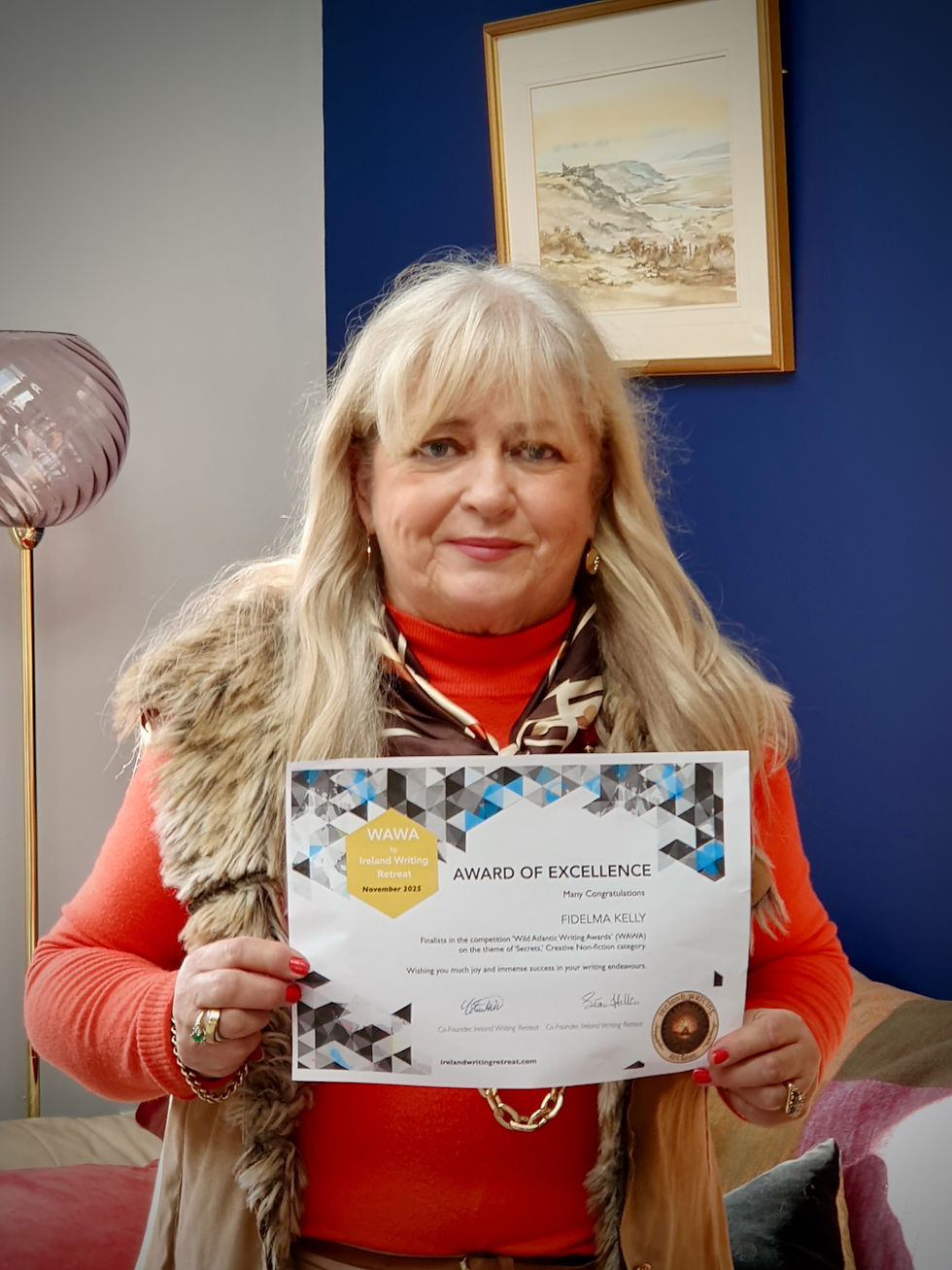
In terms of her writing experience, she said, “I’ve published longer fiction – three novels – for a more commercial market. But I find my current writing is trending in the literary, creative non-fiction direction.”
She said her WAWA story about finding out who her real father was emerged from her experiences caring for older family members. “Over the past thirteen years, I’ve been caring for elderly relatives – first an aunt, then my parents. I observed how as their ‘filter’ on past lives ‘relaxes’ they speak very openly about secrets previously kept.”
Talking about the most difficult challenge in writing her story, she said simply, “Perhaps how much I could relax my filter when writing this piece!”
Choosing her story title was not automatic. “The front-runner for a long time was ‘The Truth’ but then I settled on ‘Larry,’ the name of the character we never meet.”
As for her writing strengths and weaknesses. “Strength and depth in my characterisation: my characters have authentic if fictional lives. Weakness? Probably excess subtlety – assuming the reader can read between the lines and not spelling out everything.”
Fidelma describes her taste in books as ‘eclectic.’
“I enjoy literary and popular fiction. My criterion is the quality of the writing in whatever genre – attention to detail and accuracy in setting and authenticity of characterisation.”
Her three favorite books are 'Black Butterflies' by Priscilla Morris recounting the Siege of Sarajevo in the 1990s, 'Girl in the Making' by Anna Fitzgerald, written in the child’s voice of the protagonist, exploring the 1960s and 1970s in suburban Dublin, and 'Show Me Where It Hurts' by Claire Gleeson.

Larry
by Fidelma Kelly
My hand hovers defensively in the small of his back as he tackles the stairs. He knows nothing of my cautious protection: his ninety-year-old legs take all his concentration to climb the first turn of seven steps.
He ignores the rail specially fitted to assist him, preferring instead to grasp the naked wall with his leading right hand. I’ve only recently trained him to abandon his walking stick when using the stairs – an accident waiting to happen.
We are on a mission – he and I. Not that he fully understands it, but at least he’s co-operating. My mother’s carer is with her in the small dining-room to the rear of the house that has become Mam’s personal fiefdom. After decades of observing the external world through the large picture windows looking onto the busy thoroughfare, she now prefers the interiority of her own head and the empty outlook of the mature back garden.
I hear her babbling chat – punctuated by the occasional squeal or reprimand as this Filipina angel tries to do her hair. The carer knows Dad and I are not to be disturbed. Up in the office. Doing finances. In the years she has been helping us, the one thing I know she respects is money.
I sit my dad down on his old office swivel chair. He steadies himself, its motion no longer accustomed. I take the swabs from their envelope – line up the containers – and try to insert one into his mouth. He clamps his jaw shut, then distracts me with questions.
“Why are we doing this? he intones, a wobble in his voice. “I don’t understand!”
I cannot say, “It’s about Larry.” I cannot hurt him anymore than he’s already been hurt. Nor can I let him – or my mother go – without knowing the truth. My truth. I invent a rogue genetic illness as pretext and he acquiesces the second time.
But as I complete my test, he looks at me through eyes blurry with tears.
He knows. He’s not the one with Alzheimer’s.
*
I sit in the car outside their house. The post arrived this morning. I don’t know why I’ve resisted opening it till now, but its contents belong to Dad as much as to me. I slit the seal – then hesitate, recalling the only time I met Larry.
When Waste-of-Space – my father’s useless former employee – passed away, I took my opportunity, donned a conspicuous, floral dress and made my way to the funeral church. It was easy to deduce which one was the deceased’s brother-in-law. Larry: tall – but stooped now. That shock of hair? Thin and scraggy. I introduced myself – there representing my parents – and decrepit as he was, he flirted with me.
I looked into his slitty, hooded eyes and took my leave.
*
The results sit on the dashboard of my car: 99.9% familial match. I fold the page in half, stuff it into my pocket and go into the house to give my father a hug.


Comments